
Blog

What is going on in Listed Property

In this note we will look at what is going on in listed property,  the key themes to emerge over the past month from the profit results and how we expect listed property to perform over the next year. Given the name of our firm it would be remiss not to mention that this week marked the 60th anniversary of the publication of the Ayn Rand novel Atlas Shrugged. This novel provides an examination of whether the pursuit of profit is a noble enterprise or the root of all evil and the conflict in society between thinkers relying on facts and those defying reason, supporting their arguments on feelings.

Since 2012, listed property has been one of the top performing sectors on the ASX 200. During this time, other sectors in the equity market have faced concerns about a rising and then falling AUD, volatility in commodity prices that saw BHP abandon their cherished progressive dividend policy, Eurozone issues, near zero interest rates, and bank capital raisings. Listed property meanwhile seemed to be immune to these destabilising forces.
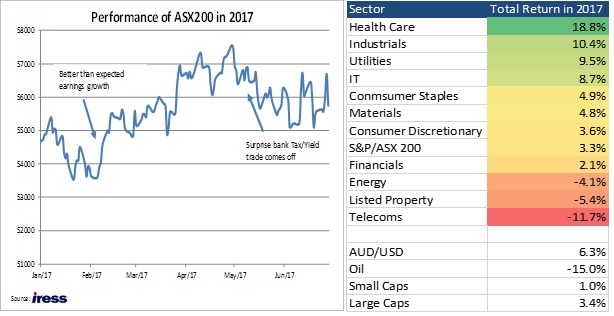
This all changed in the second half of 2016, when “safe” stocks such as Listed Property Trusts and infrastructure stocks, considered to be alternatives to bonds or term deposits, fell heavily on expectations that global interest rates will start to rise in the future. In the February 2017 results reporting season the management teams of the listed property sector addressed investor concerns about the impact of higher interest rates and their ability to grow distributions in a higher inflation environment. This increased investor confidence and accordingly saw the Listed Property sector gain 7% from the lows reached in November 2016.
As real estate is not a homogeneous asset, it is useful to break down the real estate held by the Listed Property Trusts into four distinct groups: shopping centres (retail), office towers (office), housing and apartment developers (residential), and manufacturing or distribution centres (industrial).
Retail
Discretionary retail continues to face the challenges of on-line competition to bricks and mortar, a higher AUD, and slower inbound tourism which has reduced profit margins, particularly in clothing and footwear. Weaker retail sales limit the ability of shopping centre operators such as Scentre and Vicinity to raise rents and typically a rental contract will include a percentage of store sales. New clothing retailers Zara continue to take sales away from department stores like Myer, which is important given department stores are typically the largest rent payer in a shopping centre. Additionally, over the last year shopping centre landlords faced a few tenants closing stores due to insolvency such as Payless Shoes, Howards Storage and Pumpkin Patch.

Whilst the outlook for retail looks difficult, we do not see that shopping centres will become redundant, but they will need to evolve by favouring tenants that offer services that can’t be delivered on-line such as personal grooming and dining.

Office                                     
In contrast to shopping centres, the Australian CBD office market looks pretty healthy for owners of office towers such as Dexus and Investa Office. Vacancy is the best measure of the health of the office sector, as empty floors in an office tower don’t earn rental income for the owners of office property trusts. Overall the market looks stable, but the picture across Australia is quite divergent with vacancy at a 23-year high in Perth being offset by very low vacancies in the Sydney and Melbourne markets.  Sydney and Melbourne have benefited from the conversion of office towers into apartment buildings, which reduces supply, whilst Brisbane and Perth face excess supply from towers built towards the end of the mining boom.

Residential                                     
Unsurprisingly the buoyant residential market in Sydney and Melbourne boosted the results of major residential developers Mirvac, Lend Lease and Stockland. Going into the profit results we were concerned that these developers could face defaults from buyers that have paid deposits for apartments (particularly in Melbourne). A buyer may refuse to complete a sale (thus forfeiting their deposit) if after completion the value of the property has declined or the buyer has had trouble obtaining finance. Our concerns were allayed in February with the developers reporting minimal defaults and healthy forward sales.

Industrial                              
Although the industrial assets continue to be priced higher, the underlying fundamentals have deteriorated with vacancies rising across the sector. Unlike office towers which are relatively homogeneous assets – which means, for example, that an accounting firm can take over space vacated by a financial planner – industrial sites are often configured for a particular tenant. A great example of this is the challenges the BWP face in filling sites vacated by key tenant Bunnings. The industrial trusts have continued to generate profits from re-zoning industrial property to residential. In October Goodman sold an industrial park in Sydney’s north west for $200 million to apartment developer Meriton Group.

One Year Outlook                                   
The total return (capital growth plus distributions) that investors can expect from Listed Property based on four financial components. These are; 1) distributions, 2) movement in asset values as measured by the capitalisation rate which is the rate of return on a real estate investment property based on the income that the property is expected to generate3) expansions or contractions in the market price to earnings ratio and 4) movement in the number of shares on issue (current buy backs or equity issues).

Over the next year, we see a small increase in the average distribution yield and a slight increase in asset values. However, due to concerns about interest rates it is hard to see an expansion in the market price earnings ratio above its current long term average and there are no significant buy backs currently in operation.  Consequently, it is hard to make the case that the bulk of returns that investors can expect from listed property will not come from distributions.

Our Take

The Property Trust sector as a whole appears to be trading at a premium to fair value. We see that catalysts which propelled the sector up over the last three years have largely been played out and the majority of returns over the next 12 months will come from distributions and income from writing call options over existing holdings. The sector currently trades at a +26% premium to net tangible assets (14.2x forward PE and 5.2% yield).  The portfolio strategy of the Atlas High Income Fund of populating the portfolio with higher quality domestic rent collectors combined with a derivative overlay strategy to enhance income should outperform in this market. Further, the focus on trusts that are delivering recurring yield should result in a higher distribution yield and lower earnings volatility for our investors.

Hugh Dive CFA
Chief Investment Officer

Behind the scenes in reporting season

Over the last two weeks and for the next fortnight, visitors to the Sydney CBD may have noticed stressed analysts and fund managers in sharp suits moving about with unusual velocity and with a slightly greater degree of self-importance than normal. Simultaneously, stories from financial journalists are migrating to the front page of the paper. The cause of these phenomena is the ASX-listed company profit reporting seasons, which occurs twice a year with the regular timing of the Serengeti wildebeest migration.

Reporting season is a stressful time, as it reveals how a company is performing in financial measures such as profit, margins, debt and free cash flow, as against the expectations in analysts’ models that are used to derive a valuation. When companies reveal unpleasant surprises or point to problems in the future, the company’s stock price can decline sharply. Alternatively, it can be very pleasant when the company reports a good result which validates the investment case for owning their shares. In this week’s piece, we are going to go through how Atlas approaches each day during reporting season and what happens during a typical day in the earnings reporting season.

Before the day
In mid-January and July (in advance of the August season), Atlas reviews the companies in the portfolio and looks at our expectations for key factors against both the company’s guidance and consensus analyst forecasts. The purpose of this exercise is not so much to identify companies performing ahead of expectations, but to find those in the portfolio that have the potential to cause losses on results day. Take for example Primary Health: the weak Medicare data coming through over the past few months combined with ongoing uncertainty over Government health policy would have alerted investors to the possibility that the company was facing tougher conditions that the market expected.

On results day all is revealed
Companies normally post their results with the ASX around 9am, which gives investors some time to digest the numbers and develop a view before the stock begins trading at 10am. During this period, we will be combing through the profit and loss, balance sheet and cash flow statements, comparing our forecasts to what the company delivered. Also, it is important to compare how a company has performed against their peer group. For example, Woolworths report their results next Wednesday (22 February) and the share price reaction will be strongly influenced by how the grocery business performed relative to Coles (+1.3% sales growth and 4.6% profit margin).

Company management will then formally present their results to shareholders on a conference call or at their offices during the morning, generally between 9:30am and midday. These presentations are directed towards the institutional investment community and are effectively closed to the media and public. They can take between thirty minutes and two hours, with the management having the opportunity to explain their results and discuss factors that will influence future profits. If the company has had a poorly received result and the stock price is falling, this will give management the opportunity to calm the market and clear up some uncertainties.

The most informative part – in our opinion – is always the questions section at the end as it gives investors the chance to see how confident management are in dealing with the issues that investors may have with the financial accounts after they have departed from the prepared scripts. Earlier this week, many investors observed that Australia’s largest office landlord Dexus Property struggled when explaining the amounts and accounting treatment of the cash used to break interest rate hedges. Whilst this sounds innocuous, listed property trusts exclude the payment for breaking these hedges from their current profits, yet highlight the earnings growth from lower interest costs in future years. In our view this is accounting smoke and mirrors!

Typically, it will only be the sell side analysts asking questions of management in the results presentation, with the large institutional investors saving their questions for their own individual meetings with management. However occasionally fund managers become frustrated when company management receive “soft” questions from the sell-side analysts after releasing a result that disappointed the markets. These soft questions can be the result of some sell side analysts wanting to protect their relationship with the company. The last time that I asked a question was a few years ago at a QBE Insurance result. The stock price was down 10% on the day due to some surprise provisions. Here I was frustrated by the analysts asking benign questions about future years’ depreciation charges, and this prompted me to inquire as to “What comparative advantage does QBE have in writing Argentinian workers compensation insurance?”.

Afterwards
In the week after the results, the company will organise one-hour meetings with their domestic and international institutional shareholders. In these meetings, it is important to be well prepared to maximise the value of the time that you get with management, as this is often a key factor when deciding whether to commit investors’ capital to the company. Whilst these meetings can be either quite hostile or very friendly, they are a valuable forum for both parties to give feedback on not only how our clients’ capital has been managed in the past, but also how that capital should be employed in the future.
In recent meetings, one of the key topics that I have discussed with management is their attitudes to debt and gearing. Currently investment grade companies can obtain debt at historically low prices and –  more importantly  – with long duration, which would suggest that companies should raise their gearing to boost returns. The counterpoint to the thesis of increasing borrowings is the lingering memories of the GFC. Accordingly, many companies are reluctant to pay high prices for existing assets or do not have sufficient confidence in the economic outlook or political stability to spend capital.

Trading – measured decisions not made in haste
Whilst the stock-broking community would clearly prefer that fund managers trade immediately and often based on company results, the decisions to make dramatic changes to a position for fundamentally-based fund managers will only occur after sober analysis of the company’s results. The fund manager will then examine what changes are made to valuations and look at the set of competing investment opportunities and their expected returns including cash. We believe that most of the trading volume on the day of a result is either due to short term momentum-based hedge funds, or most likely the machines behind algorithmic trading. This may explain moves such as we saw earlier this week with Treasury Wine, who after reporting was down -5% on Monday, but gained +4% on Tuesday.

Reporting season is like Christmas for investors, in that we get to have a close look at the companies in which we have entrusted our capital, examine the financials, and ask questions of the management teams running these companies. Additionally it can give us a greater insight than ABS statistics into what is actually happening in the economy.

Hugh Dive CFA
Chief Investment Officer